
When the building is made in a factory, the technology should be planned from the start.
In modular and prefab construction, walls, floors, bathrooms and complete room modules are built in the factory and only assembled on site. This saves time and money. Prefabrication pays off most when building services and networking are standardised as thoroughly as the building elements.
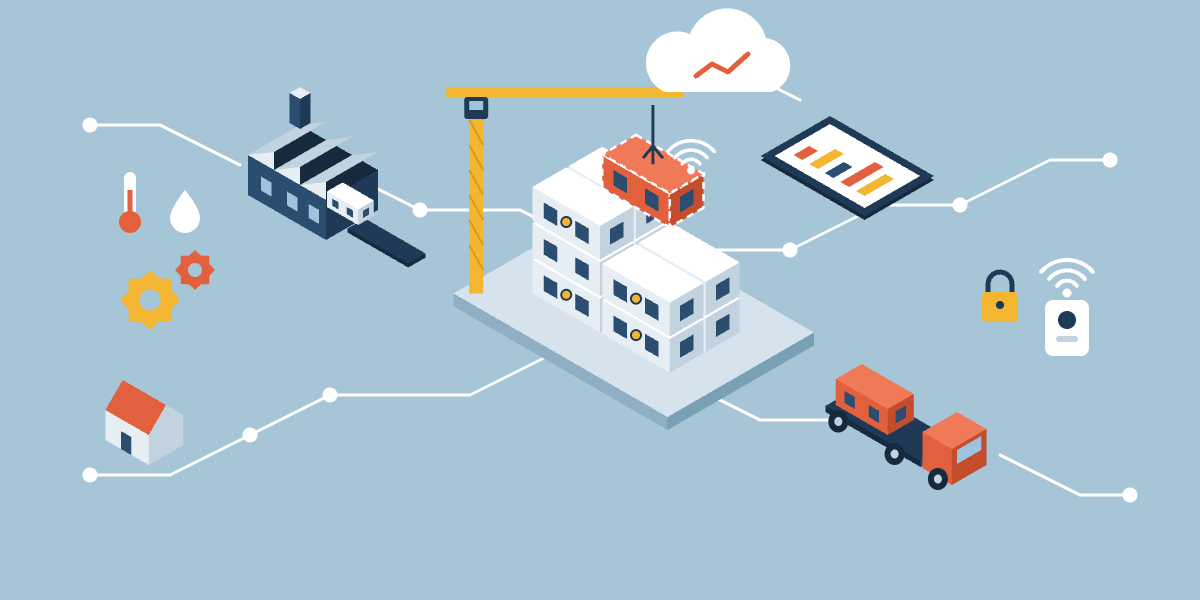
Why IoT and modular construction belong together
Conventionally, every building is planned, wired and commissioned individually. In serial construction, the same set-up repeats from module to module and from building to building. Sensors, wireless network and building control can therefore be planned carefully once and then repeated as often as needed: installed in the factory, connected on site and commissioned from a fixed template.
Where IoT adds value
- In the factory: sensors and cable routes are installed during prefabrication and tested before delivery. Every module arrives on site with documented technology.
- Transport and assembly: the location and condition of modules can be tracked. In timber construction it is especially important to monitor moisture in the elements during storage and assembly, before damage occurs.
- Commissioning: the building network, internet connection and building control (Building Operating System, BOS) are set up the same way in every building. This makes commissioning predictable and fast.
- Operation: indoor climate, energy, timber moisture and building services are measured continuously. AI analysis detects anomalies early, so maintenance can be planned ahead.
- Warranty and quality: measured data shows how the building and its technology actually perform – a solid basis for manufacturers, developers and operators.
Serial renovation
The same principle is reaching existing buildings: prefabricated façade and roof elements, some with integrated building services such as ventilation or heat pumps, are mounted onto the existing building. Simple buildings from the 1950s to 1970s with high energy consumption are particularly suitable.
IoT sensors measure what the renovation actually delivers: energy use and indoor climate before and after, continuously and verifiably. The sensors are retrofitted wirelessly, without new cables in an occupied building – just like our IoT retrofitting.
Experience from the field
In 2026, nordSENSORS took on electrical site management on serial timber construction sites in Berlin and Immendingen and coordinated the Building Operating System (BOS) on site – from the temporary satellite internet connection to the building network and mobile failover.
What nordSENSORS delivers
- Planning: sensors, wireless network and building network as a repeatable template for your module or building type.
- The right wireless technology: LoRaWAN for many sensors at one site, NB-IoT for individual, distributed measuring points.
- Site management and commissioning: coordinating electrical work, network and BOS on site, finding and fixing faults.
- AI-powered data analysis: analysing measurements and detecting deviations early.
- Operation and service: support for sensors and platform after handover.
From Estonia
Estonia is Europe’s largest exporter of prefabricated timber houses. From here, nordSENSORS works for manufacturers, construction companies and housing companies in Estonia and Germany.
Building or renovating with prefabrication? We plan the technology alongside.