
Your refrigeration system controls, our sensors check.
A second, separate measuring layer alerts you immediately when the temperature in a cabinet is wrong, no matter what the controller shows.
The situation
In October and November 2026, attackers in several European countries remotely manipulated the refrigeration systems of supermarkets and food businesses, including in Estonia and Germany. Display cases and freezers warmed up, and goods had to be thrown away.
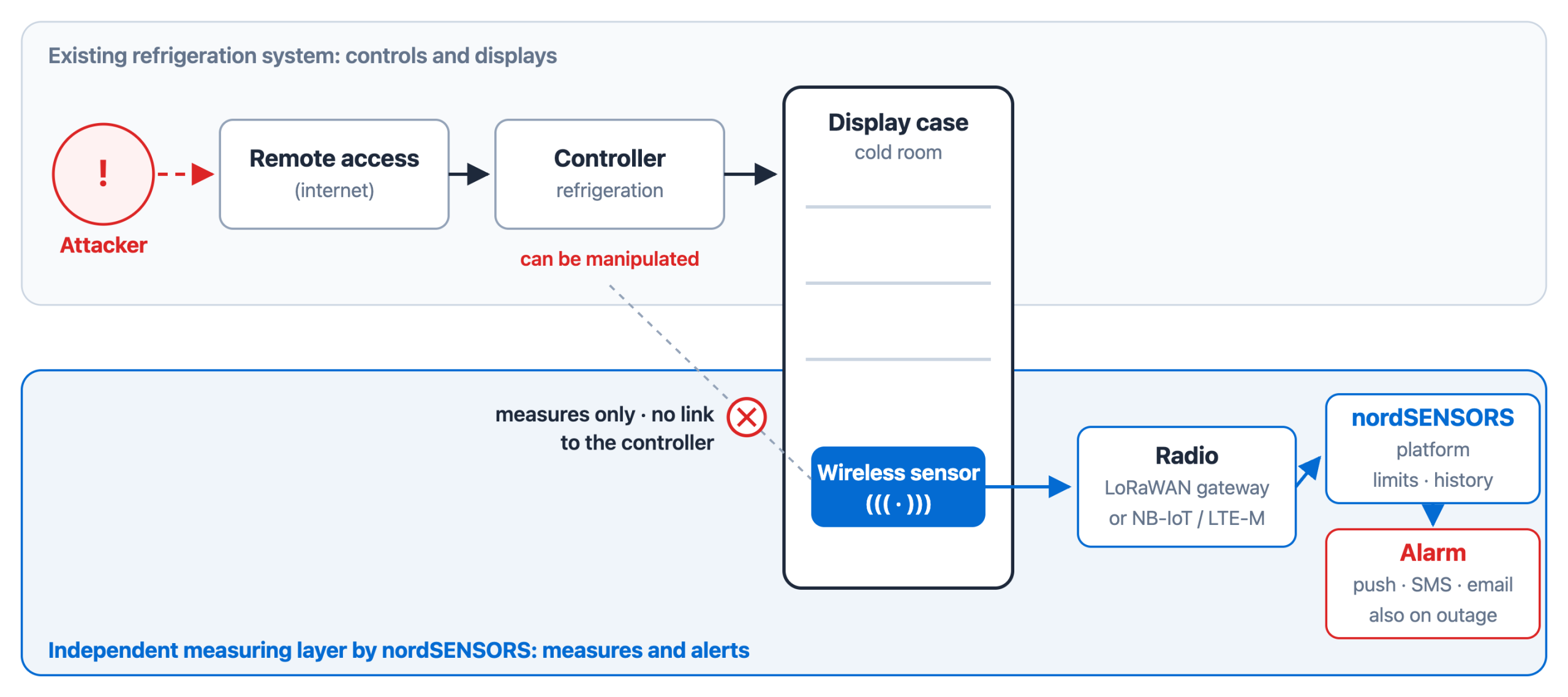
The way in was usually the remote controllers of the refrigeration systems: reachable directly from the internet, running outdated software or still using default passwords. The danger: the attacks ran at night, when nobody was in the store. And whoever takes over the controller can also switch off its own alarms.
The attacks show a basic rule: if you only look at the system itself, you only see what the system reports.
The principle: measure, don’t control
We add a second measuring layer next to your refrigeration system. Our own battery-powered sensors measure the temperature directly inside the cabinet and send the readings over a separate radio network to our platform.
- Separate: the sensors have no connection to the refrigeration controller. An attack on the system does not reach them.
- Read-only: the sensors measure and transmit, they cannot switch anything. No new remote access to your refrigeration is created.
- Complementary: your existing system stays as it is. We replace nothing, we check independently.
- Retrofitted in minutes: wireless instead of cables, installed without touching the refrigeration equipment.
Two options
The right radio technology depends on the number of measuring points and how your sites are spread out. Both can be combined.
| LoRaWAN | Cellular IoT (NB-IoT / LTE-M) | |
|---|---|---|
| Setup | sensors + one gateway on site | sensor with SIM card, no gateway |
| Best for | many measuring points at one site | single, distributed sites |
| Examples | supermarket, kitchen, cold store, warehouse | petrol station shop, kiosk, reefer container, outdoor store |
| Network | own radio network, independent of company Wi-Fi | public mobile network |
| Running costs | low, no SIM fees per sensor | mobile tariff per sensor |
| Battery life | several years | several years, depending on transmission interval |
Estonia offers a good basis for cellular IoT: according to the operator, Elisa’s NB-IoT network covers 95% of the country.
More than sensors: what nordSENSORS delivers
- Alarms that get through: limits per cabinet, alerts by push notification, SMS and email, with escalation to a second person if nobody responds.
- Outage alarm: if a sensor stays silent longer than agreed, you get an alarm too. Radio interference, a flat battery or sabotage do not go unnoticed.
- Secured operation: individual keys for every device, encrypted radio transmission, platform access only with two-factor login. The monitoring itself does not become the weak point.
- Documentation: a complete temperature history for HACCP and food inspections, available for export at any time.
- On-site service: planning, installation and support by our team in Estonia, in English and German.
Who it is for
- supermarkets and food retailers
- restaurants, hotels and commercial kitchens
- butchers, bakeries and food production
- cold stores, logistics and wholesale
- pharmacies, clinics and laboratories that store medicines or samples
How it works
- Consultation: we go through your refrigerated units, limits and who should respond to an alarm.
- Planning: on-site radio check, choice of LoRaWAN, cellular or both.
- Installation: mounting the sensors and, if needed, the gateway, without touching the refrigeration system.
- Operation: alerting, outage monitoring, battery replacement and updates, all handled by us.
FAQ
Does this replace my refrigeration system or its maintenance?
No. Your system and your refrigeration contractor stay. Our sensors are an independent check alongside them.
Can attackers change my refrigeration settings through the sensors?
No. The sensors only measure and have no connection to the controller.
What happens if a sensor fails?
You receive an outage alert as soon as it stops sending data for longer than agreed.
Do I need Wi-Fi or internet on site?
Not for cellular sensors. For LoRaWAN the gateway needs an internet connection, which can also run over mobile data.
How long do the batteries last?
Several years, depending on the transmission interval. We take care of replacing them.
Do you know whether your refrigeration is cooling properly right now, without blindly trusting the system? We are happy to advise you.